

A blog that earns from display ads hands the ad space on its pages to a company that sells it to advertisers. Each of these companies sets its own entry test, and the tests count different things, so a number on one network’s page cannot be set against a number on another’s. This guide puts the official requirements side by side with the date of each page, then shows what to fix before you apply. Display ads are one route among several for a blog that gets visitors from Pinterest, and the others are in our guide to the real ways to make money with Pinterest (opens in a new tab). The entry rules of all four routes, ads included, sit side by side in our overview of how to generate income from a blog (opens in a new tab).
The pages in the sources were read on 19 November 2026, most of them for the second time after a first reading on 26 October 2026. Raptive’s Help Center pages could not be opened on 19 November 2026 (they answered with a bot check), so this guide gives no Raptive figure. Requirements change often, so check the network’s page again on the day you apply.
What an ad network does for a blog
Google describes AdSense in three steps. You make ad spaces available by pasting ad code on your site and choosing where ads appear, advertisers bid for those spaces in a real-time auction, and Google bills the advertisers and pays you.
Other companies do the same job with more hands-on work. Mediavine says in its Help Center that it is not an ad network and describes what it does as full-service ad representation: it manages your ad server, helps you place ads and sets price controls. This guide uses the words ad network for any company that sells your ad space for you, whatever it calls itself.
Display ads and premium programmatic networks
Display ads are the image and text ads that sit around your content. AdSense and Mediavine both describe the same mechanism: each ad space is sold in an automatic auction and the highest bid wins. Mediavine’s pages call this programmatic advertising, and they set it apart from affiliate ads, sponsored posts and directly sold ads, which you keep control of.
Mediavine adds that your pages run a mix of display, video and high-impact formats, with display as the backbone because it draws on the deepest pool of bidders. It also says video ads usually pay more than display, which is Mediavine’s own claim and not something this guide checked.
For you the practical difference is who decides. With AdSense you paste the code and pick the placement. With a managed program such as Mediavine, the company takes over the ad server and placement, reviews your site before accepting it, and asks for control of your programmatic ads in return. The sections below show what each asks before it accepts you.
What each network officially requires
The table lists what each network’s own page asks for. The date is the date shown on the page or, when a page shows none, the day it was read.
| Network | What its official page asks for | Page date | Our guide |
|---|---|---|---|
| Google AdSense | Original, high-quality content that follows the AdSense policies, an applicant aged 18 or over, and access to the HTML source of the site. The page lists no traffic minimum. | No date shown, read 19 November 2026 | In the AdSense section below |
| Journey by Mediavine | 5,000 sessions a month from the U.S., the U.K., Canada, Australia, Germany, France or the Netherlands, original content, Mediavine’s content quality and traffic standards, and a domain at least 4 months old. | Modified 17 November 2026 | Journey by Mediavine explained (opens in a new tab) |
| Monumetric, Propel program | A WordPress or Blogger site with a sidebar at least 300px wide, 10K to 80K pageviews per month, at least six ad slots, approval by major advertisers, a $99 implementation fee and at least 50% of traffic from the U.S., U.K., Australia and Canada. | Published 15 September 2026 | In the Monumetric section below |
| Raptive | Its Help Center eligibility page could not be opened when this guide was checked, so no figure is given here. Read it on Raptive’s own site before you apply. | Not readable on 19 November 2026 | Raptive requirements checked in Analytics (opens in a new tab) |
| Mediavine | $5,000 in annual ad revenue, original content, clean human traffic, good standing with Google AdSense and AdExchange, and a reader experience that supports premium ads. | Modified 17 November 2026 | Mediavine requirements explained (opens in a new tab) |
| Ezoic | 250,000 or more monthly active users, with exceptions for sites that joined before 19 February 2026 and an Incubator program below that level. | Shown only as updated over a month ago, read again 19 November 2026 | Ezoic requirements and the Incubator (opens in a new tab) |
How to read the units
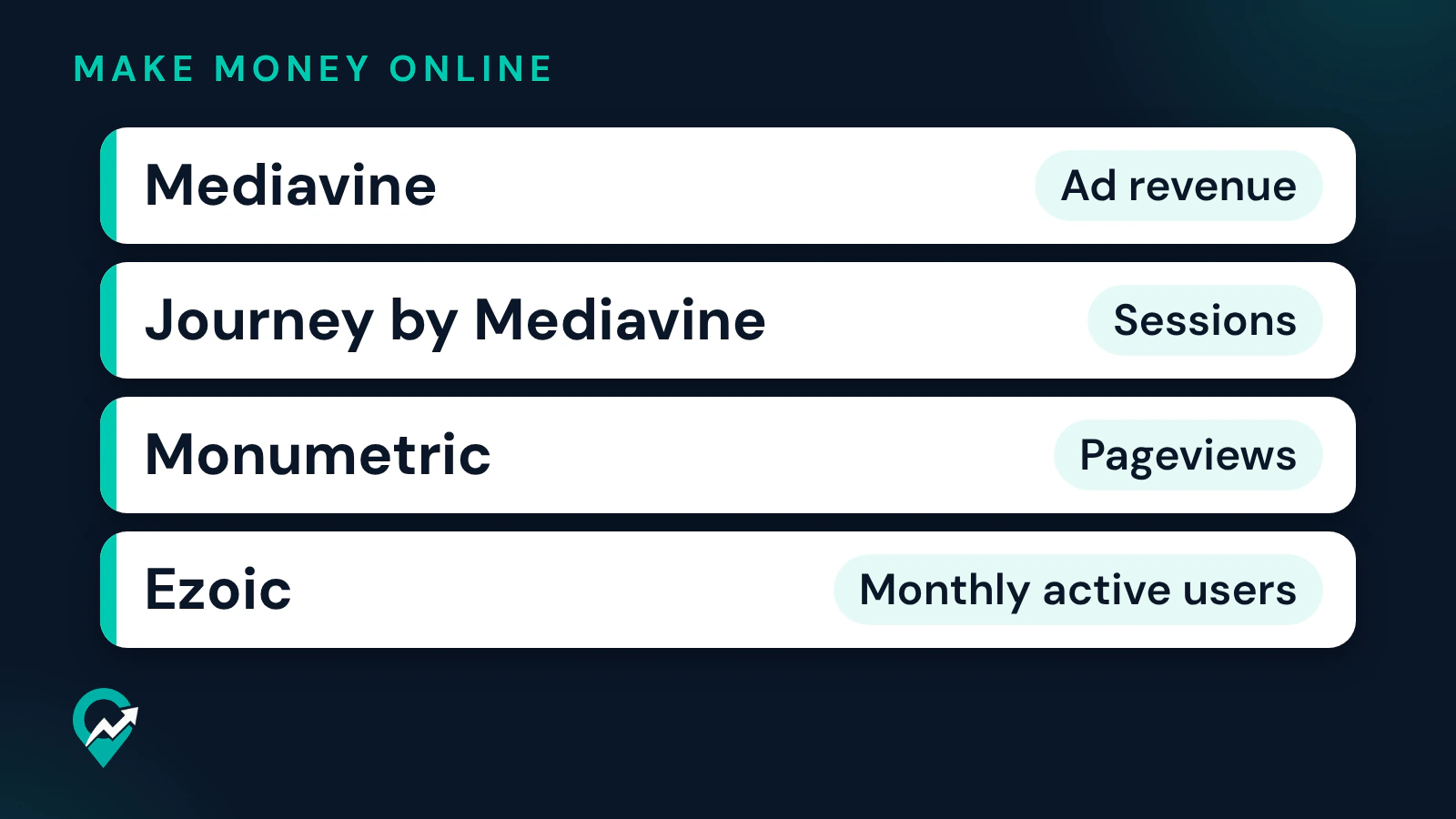
The units are different, so do not compare the numbers line by line. Google defines a session as a period of time during which a user interacts with your site, and a single session can contain several page views, so 1,000 sessions and 1,000 pageviews are not the same amount of traffic. Mediavine’s main program counts money, Journey counts sessions, Monumetric counts pageviews and Ezoic counts monthly active users.
Requirements that changed
An older page can stay online after a network changes its rules. Mediavine’s own 2023 post on its application process, modified in May 2025, still gives 50,000 sessions per month as the minimum. The requirements page modified on 17 November 2026 gives $5,000 in annual ad revenue for the main program and a session test for Journey instead. Ezoic’s page says that sites monetizing with it before 19 February 2026 keep their place regardless of size as long as they maintain continuous use of Ezoic, and that any new site added to an existing account after that date must meet the 250,000 level.
Two pages can also disagree on detail. Monumetric’s requirements page says 10K to 80K pageviews per month for Propel, while its program overview says that range must hold for 3 consecutive months. Where this guide finds a conflict it names both pages.
The networks one by one
Mediavine
Mediavine’s main program asks for $5,000 in annual ad revenue and reviews content, traffic quality, your standing with Google and the reader experience. It also requires exclusive control of your programmatic advertising, and its initial contract term is 90 days, after which it rolls month to month with 30 days’ written notice. Our guide to what Mediavine’s requirements mean (opens in a new tab) goes through each condition and how to check yours.
Journey by Mediavine
Journey is Mediavine’s self-supported program for sites that do not yet meet the main revenue requirement. Mediavine says a Journey site that later reaches the revenue threshold is evaluated automatically for the main program. The details are in our guide to Journey by Mediavine for growing sites (opens in a new tab).
Raptive
Raptive’s home page describes a selective network of creators. Its Help Center pages on eligibility, Google Analytics and ads.txt answered with a bot check on 19 November 2026, so this guide does not repeat their conditions: read them on Raptive’s own site on the day you apply. Our guide to how Raptive’s eligibility is checked (opens in a new tab) shows how to measure your own numbers in Analytics.
Ezoic
Ezoic’s review of a new site has two parts. Its own team reviews the site, and Google’s Multiple Customer Management review gives access to Google’s ad exchange. Ezoic says the first typically concludes within 10 days and the second can take up to 18 days. Below 250,000 monthly active users a site can apply to the Incubator program, which Ezoic says takes 20 publishers per month in a competitive selection. The full conditions, including the date of 19 February 2026, are in our guide to Ezoic’s requirements step by step (opens in a new tab).
Google AdSense
AdSense is Google’s own program, and its eligibility page lists no traffic minimum. It asks whether your content is original and complies with its program policies, and whether you are 18 or over. It also says you must be able to access the HTML source code of the site you submit.
Monumetric
Monumetric’s Propel program is aimed at sites in the 10K to 80K pageviews range. Its page requires a WordPress or Blogger site and a minimum of six ad slots, which Monumetric implements, and it requires a $99 implementation fee.
What to fix before you apply
These five checks come from conditions that several of the pages above share. None guarantees approval.
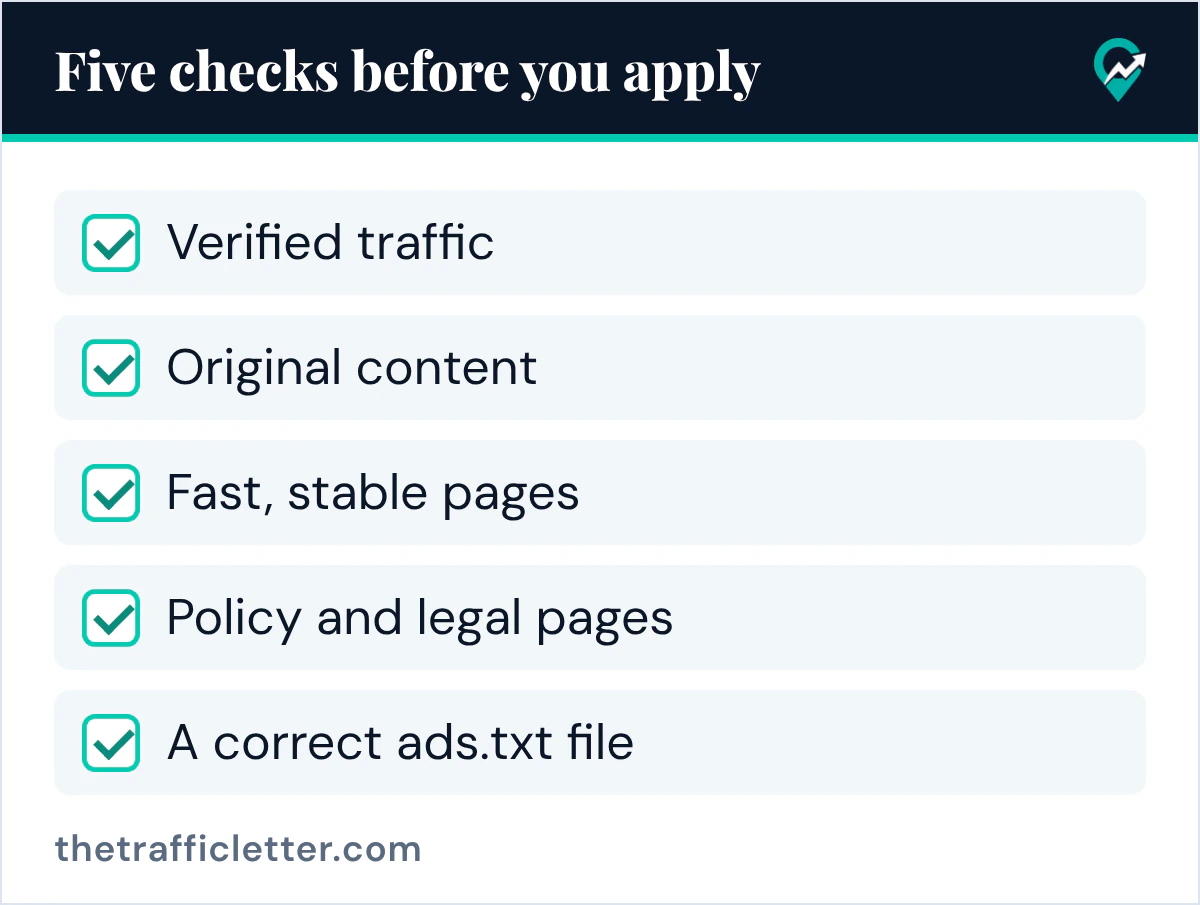
- Verified traffic. Set up Google Analytics 4 before you apply. Mediavine says its application uses Google Analytics to evaluate traffic, and Monumetric measures its country share in Google Analytics. Look at where your visitors come from, because Journey and Monumetric both set a country condition.
- Original content. The AdSense, Mediavine and Journey pages read here ask for it, Ezoic’s list of Google policies to follow includes no automatically generated content and no copied content, and Mediavine asks for content built for real users, not only for search engines or ad revenue.
- Fast, stable pages. Mediavine asks for a reader experience that gives ads room without disrupting the reader. Google’s Core Web Vitals measure loading (LCP), responsiveness (INP) and visual stability (CLS), and Google says to aim for LCP within 2.5 seconds, INP under 200 milliseconds and CLS under 0.1. Our checklist for an SEO friendly blog post template (opens in a new tab) shows how to test a theme against these metrics on a sample post.
- Policy and legal pages. Ezoic requires a privacy policy reachable from every page and a contact page with a working email address or form. AdSense requires you to follow its program policies, and Ezoic requires compliance with Google’s policies.
- A correct ads.txt file. Google describes ads.txt as a file that lists the sellers authorized to sell your ad space and says it is not mandatory but highly recommended. Mediavine says any extra line you add for another programmatic seller breaks its exclusivity, and Ezoic requires its own reseller line.
Traffic and country mix are the parts you can read straight from your own data. Our guide to building blog traffic from Pinterest (opens in a new tab) covers the source side, and the Pinterest growth guide (opens in a new tab) covers keeping that traffic steady. For a new blog, our guides to starting a blog that can earn (opens in a new tab) and to how blogging makes money (opens in a new tab) come first.
Audit your numbers against a network’s page with an AI assistant
This prompt works in ChatGPT, Claude, Gemini or any AI assistant. It asks the assistant to compare your numbers only with the requirement text you paste and to add no rule of its own. Replace the text in square brackets first.
I run a blog about [your niche]. I want to know whether my site meets an ad network's published entry requirements.

Below is the text I copied from the network's official requirements page, with the date I read it: [paste the requirement text and the date].

Below are my own numbers from Google Analytics for the last 30 days: sessions [number], pageviews [number], active users [number], share of sessions by country [list the top countries with percentages], top traffic sources [list], and the age of my domain [months].

Compare my numbers with each requirement, one line per requirement. For each line write the requirement as it appears in my text, my number, and one of "met", "not met" or "cannot tell from this data". Do not add any requirement that is not in my text and do not use any figure that is not in my message. End with the three biggest gaps and one concrete action for each.
Read the answer against the network’s page yourself. If a line says “cannot tell”, find the missing number in your analytics before you apply.
How to choose
Start from the units you can prove today. Pull the last 30 days from Google Analytics, then see which rows of the table you already meet. A site with 5,000 sessions a month from the countries Journey lists meets its session test. This is an example of how the tests work, not a promise of approval, since every network read here sets other conditions too.
Then read what you give up. Mediavine requires exclusive control of your programmatic advertising and, in its terms, a Traffic Assignment Letter that lets it sell your traffic as part of its network, and it lets you keep affiliate ads, sponsored work and directly sold ads. Ezoic requires you to remove all non-Ezoic ad code from your site. If you earn from affiliate links today, our guide to affiliate marketing on Pinterest for beginners (opens in a new tab) explains what that income depends on, and Mediavine’s exclusivity page confirms that affiliate ads fit alongside its program.
Revenue share, payment schedules and earnings per thousand views differ by program and change often, so this guide does not quote them. Read them in the agreement and on the network’s own help pages on the day you apply. Our guide to what a good RPM for a blog means (opens in a new tab) explains why none of the official pages it read gives a good level and how to measure earnings per thousand views from your own data.
If you are below every minimum in the table, the work is traffic and content, not applications. Keyword research is the first lever, covered in our guide to finding Pinterest keywords that people search (opens in a new tab).
Right after: your next actions
- Open Google Analytics and write down your sessions, pageviews and country mix for the last 30 days. The steps for sessions and country are in how to check your numbers for Mediavine (opens in a new tab).
- If you are under the main Mediavine threshold, read how the Journey program for smaller sites (opens in a new tab) is set up.
- Fix the checklist above, starting with slow pages and missing policy pages, then apply on the day you have re-read the network’s page.