
A blog earns when readers arrive and something on the page pays for their visit. This guide covers four routes that do that, and each one has entry rules set by the company behind it. This guide sets out those rules from the official pages read on 10 November 2026. It is part of our guide to earning from Pinterest traffic as a blogger (opens in a new tab), and the ad side is covered in more depth in our guide to ad networks for bloggers (opens in a new tab).
The four ways a blog earns
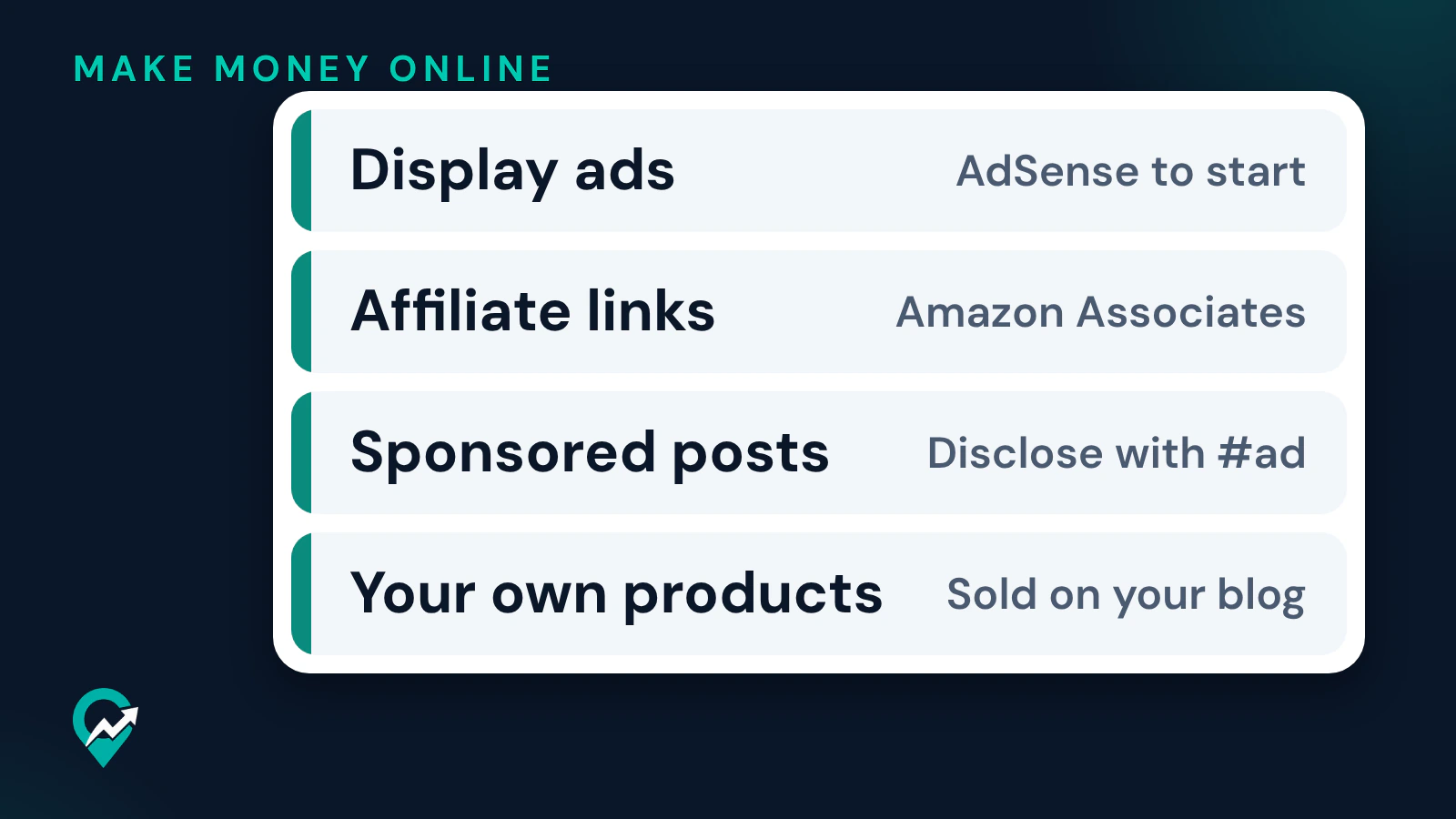
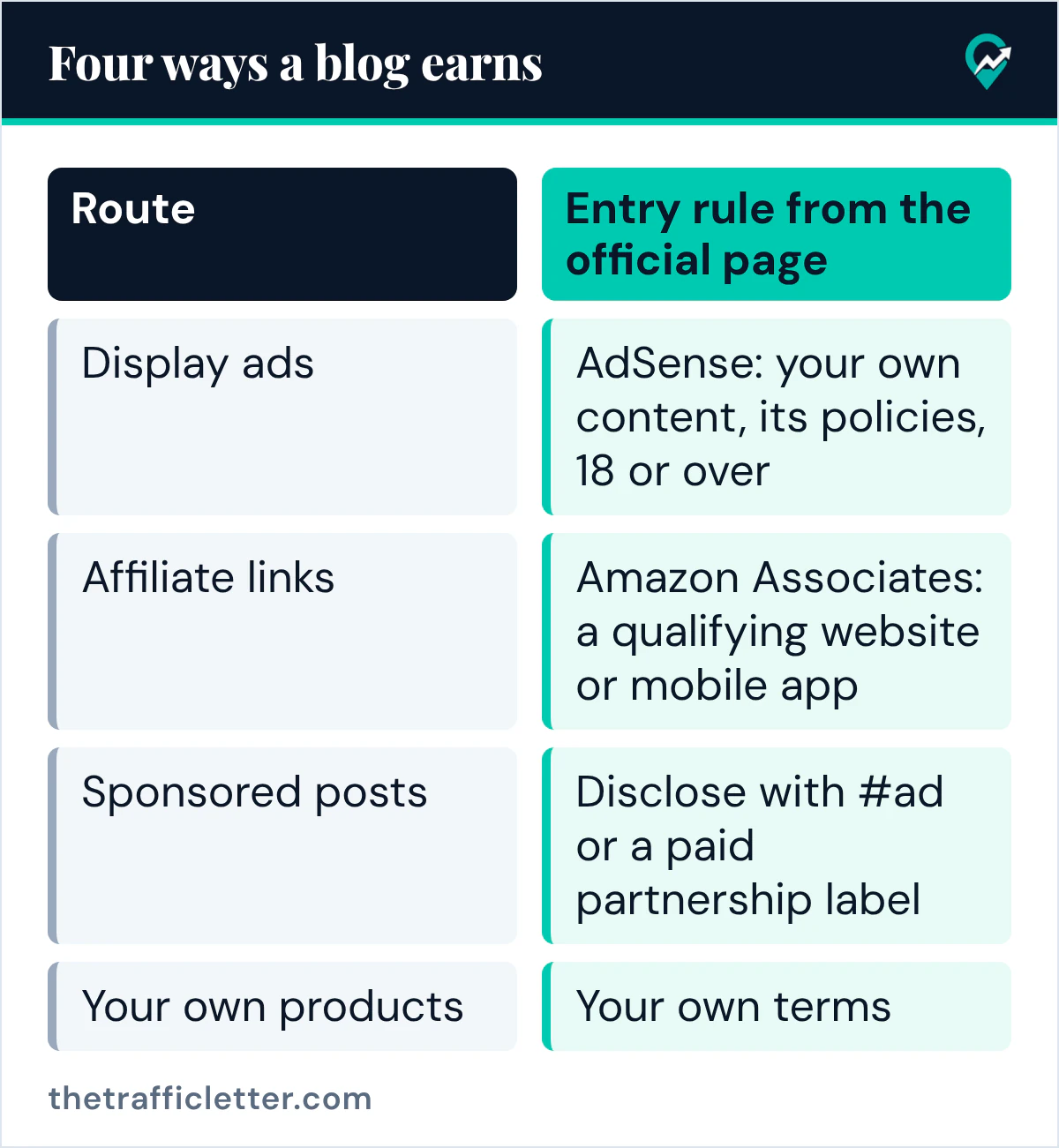
| Route | How the blog earns | Entry rule from the official page |
|---|---|---|
| Display ads | Ads shown next to your content | AdSense: your own content, its policies, 18 or over |
| Affiliate links | A commission on qualifying purchases | Amazon Associates: a qualifying website or mobile app |
| Sponsored posts | A brand pays for content | Disclose with #ad or a paid partnership label |
| Your own products | You sell a product or service | Your own terms |
None of the pages read for this guide gives a typical income for a blog, and this guide gives none either. What a route pays depends on your traffic, your niche and the program’s own terms.
Display ads: AdSense to start
Google’s How AdSense works page says AdSense matches ads to your site based on your content and visitors, that advertisers bid in a real-time auction, and that the amount you earn will vary because advertisers pay different prices for different ads. Google pays for clicks, impressions or other interactions depending on the type of ad, and the page says participation is free of charge.
The eligibility page lists what you need to sign up:
- Your own content that meets the AdSense Program policies. Google says it must be high-quality, original and attract an audience, and that you need access to the HTML source code of the site.
- An age of at least 18. Google says someone under 18 may have a parent or guardian sign up with their own Google Account.
The same page names no traffic level. One rule to remember from the How AdSense works page: clicking your own ads for any reason is not permitted.
Ad management networks once traffic grows
Ad management networks ask for a level of traffic or revenue first. The official pages read for this guide give these levels:
- Journey by Mediavine: a minimum of 1,000 sessions from Tier 1 countries (including the U.S., Canada, the U.K. and Australia) within a 30-day period, says Mediavine.
- Mediavine: a minimum of $5,000 in annual ad revenue, and good standing with Google AdSense and AdExchange.
- Ezoic: sites are generally required to have 250,000 or more monthly active users, says Ezoic, with an Incubator Program for growing sites below that level.
Our guides to what Mediavine asks of applicants (opens in a new tab) and to what a good blog RPM looks like (opens in a new tab) go further on each step.
Affiliate links: Amazon Associates and others
An affiliate link pays you a commission when a reader buys through it. Amazon says bloggers, publishers and content creators with a qualifying website or mobile app can join Amazon Associates, and that you earn from qualifying purchases and programs through the traffic you send to Amazon. Its program page says you can “Earn up to 10% in associate commissions”, that commission income differs by product category, and that it is paid approximately 60 days after the end of the month in which it was earned. Amazon also says it reviews each application.
Other merchants run their own programs with their own terms. Read the rate, the cookie period and the payout rules on the program’s page before you write about a product. Our guide to affiliate marketing for bloggers (opens in a new tab) covers where to join, the disclosure and how to mark the links. When you share affiliate links on Pinterest, its affiliate guidelines apply too, as covered in our guide to using affiliate links on Pinterest (opens in a new tab).
Sponsored posts: disclose with #ad
A sponsored post is content a brand pays you to create. On Pinterest, the paid partnership guidelines say all paid partnerships must disclose the commercial nature of their content, with a clear disclosure such as #ad or a label from Pinterest’s paid partnership tool. Pinterest’s help page says the tool is only available in the Pinterest app, where you toggle on Add paid partnership label and tap Add a brand partner, and that brands need to approve the tag for their name to appear with the label.
On your blog, say the post is sponsored near the top, before the first link. This is general information, not legal advice: the disclosure rules of your country apply as well.
Your own products: sold on your blog
A product you make yourself, such as a printable, a course or a service, is a route where you set the price and the terms yourself, without a program’s approval. The work moves elsewhere: you build the product, handle the payments and support the buyers. Start with something your readers already ask for in comments or emails, and link it from the posts that answer the same need.
Traffic comes first
Every route above needs readers. AdSense earnings vary with ads and visitors, the networks ask for sessions or revenue, and an affiliate commission needs a reader who clicks and buys. Pinterest can be one of the sources that bring those readers. Our guide to getting traffic to your blog (opens in a new tab) lists where to start.
A prompt to pick your first income route
I run a blog in the [your niche] niche with about [monthly sessions] sessions a month, mostly from [traffic sources].
My readers usually look for [what they look for].
Compare four income routes for this blog: display ads, affiliate links, sponsored posts and my own product.
For each route, say what I would need to start and one first step for this month.
Use only these program facts, which I checked on the official pages: [facts you checked].
Do not invent income figures, rates or results.
It works in ChatGPT, Claude, Gemini or any AI assistant. Check every program rule it repeats against the official page before you act on it.
Right after
- Check your sessions in your analytics and see which ad network level, if any, your blog reaches today.
- Choose one affiliate program that fits your niche and read its terms, starting with our beginner guide to Pinterest affiliate marketing (opens in a new tab).
- Plan where your next readers will come from, with our guide to getting traffic from Pinterest (opens in a new tab).