

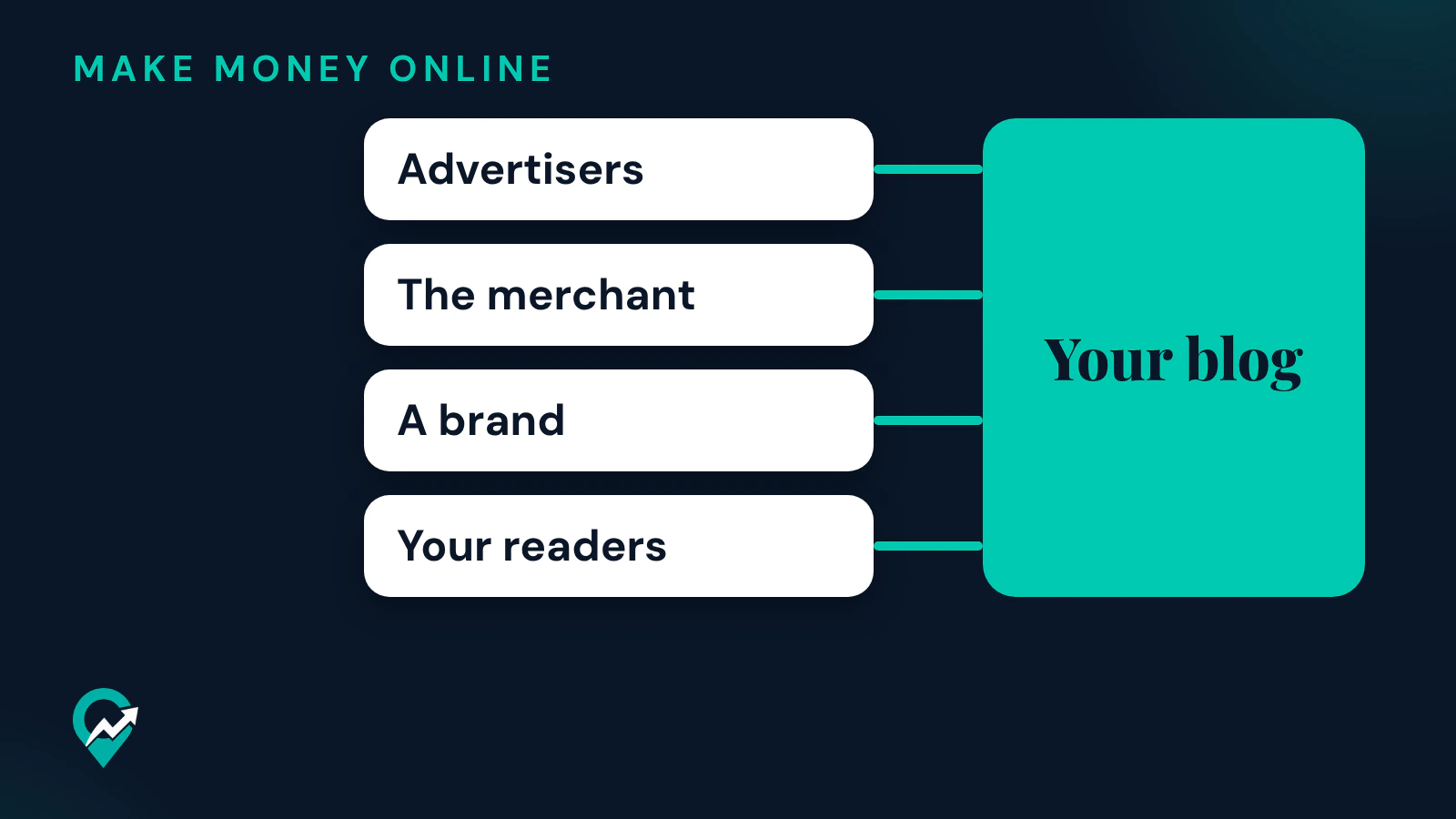

Blogging makes money when something on the page pays for a reader’s visit: an ad, a commission, a sponsor or a product. This guide explains how each of those pays, from the official pages of the programs behind them read on 20 November 2026, and what decides whether a given blog earns. It is part of our guide to Pinterest income for bloggers (opens in a new tab); the setup steps are in our guide to starting a blog to make money (opens in a new tab).
How blogging makes money, route by route
This guide covers four routes that pay a blog. Each has its own payer and its own rule.
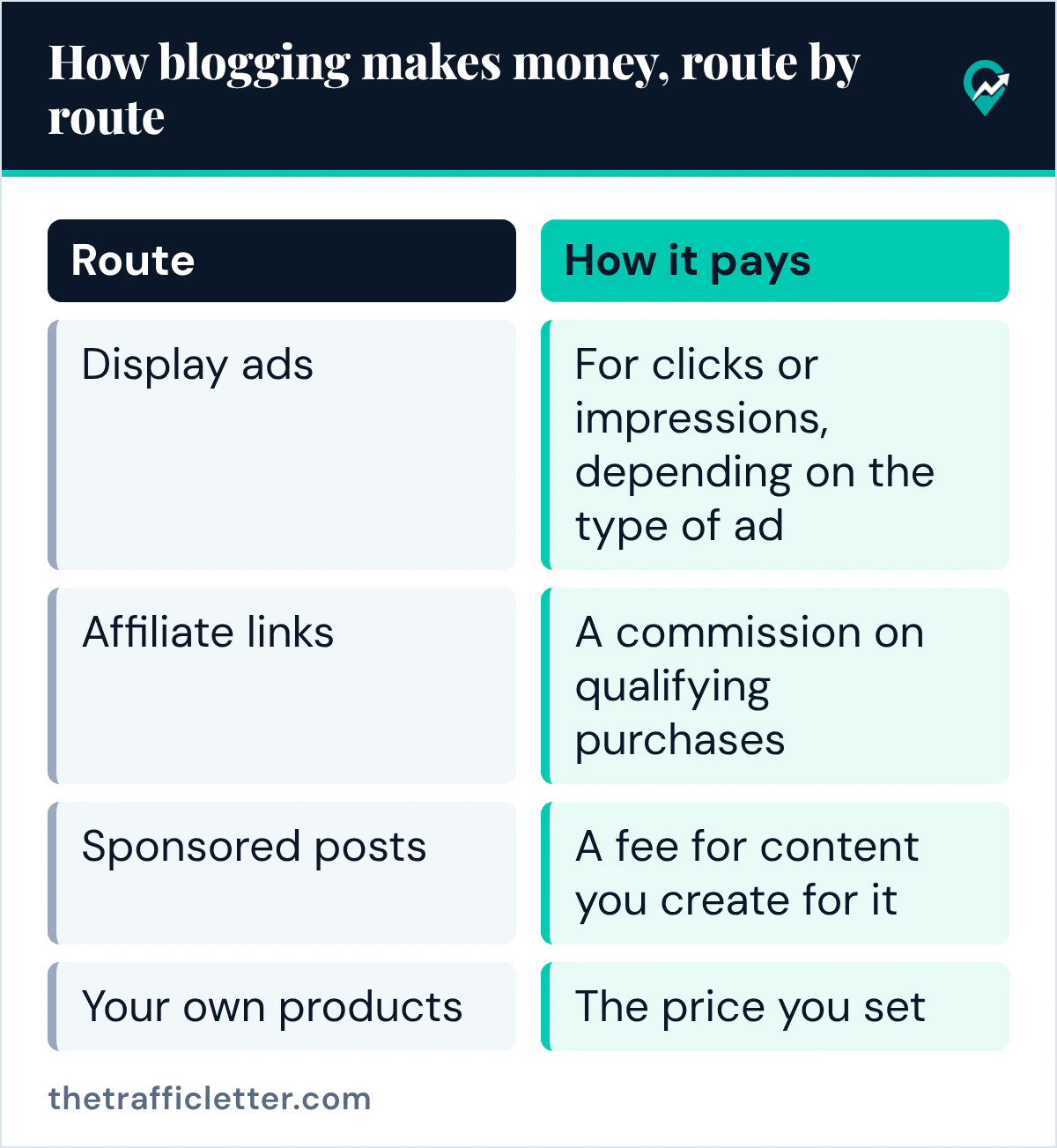
| Route | Who pays | How it pays |
|---|---|---|
| Display ads | Advertisers, through the ad program | For clicks or impressions, depending on the type of ad |
| Affiliate links | The merchant | A commission on qualifying purchases |
| Sponsored posts | A brand | A fee for content you create for it |
| Your own products | Your readers | The price you set |
The sections below cover the first three from their official pages. Your own products depend on the price and terms you set yourself.
Display ads: paid by the auction
Google’s How AdSense works page sets out the mechanics in three steps: you make your ad spaces available, the highest paying ads appear on your site, and you get paid. AdSense matches ads to your site based on your content and visitors, advertisers bid in a real-time auction, and Google pays for ad clicks or ad impressions depending on the type of ad. Because advertisers pay different prices for different ads, Google says the amount you earn will vary.
Google says participation is free of charge. To sign up, its eligibility page asks for your own content that meets the AdSense Program policies and an applicant aged 18 or over, and says the content must be high-quality, original and attract an audience.
Ad management networks such as Journey by Mediavine, Mediavine and Ezoic set a level of traffic or revenue before they accept a blog (see the table further down). Our guide to measuring ad income with blog RPM (opens in a new tab) explains how ad income is measured.
Affiliate links: paid per purchase
An affiliate program pays when a reader buys through your link. Amazon says its Associates program helps content creators, publishers and bloggers monetize their traffic, and that associates “Earn up to 10% in associate commissions from qualifying purchases and programs.” Amazon pays on qualifying purchases and programs, so the reader has to act on your link.
Google asks you to mark paid links with rel="sponsored". Our guide to joining affiliate programs as a blogger (opens in a new tab) covers the programs and the disclosure.
Sponsored posts: paid by a brand
Pinterest’s help page describes a paid partnership as a relationship in which a creator creates content with a brand that they have a material connection with, to promote the brand or its products. When you share that content on Pinterest, its paid partnership tool adds a label to the Pin, and the brand has to approve the tag for its name to appear. Pinterest says the tool is only available in the Pinterest app. On your blog, say the post is sponsored before the first link.
What decides whether your blog earns
The programs read for this guide check three things before they pay, in different ways.
- Readers. AdSense pays for ad clicks or impressions, and commissions need readers who buy. Ad networks set a level before they accept a site.
- Content. Google asks AdSense applicants for high-quality, original content, and Mediavine asks for original, audience-first content.
- Clean traffic and policies. Mediavine asks for clean, human, brand-safe traffic, and Google says clicking your own ads for any reason is not permitted.
The traffic levels ad networks set
| Network | Level on its official page |
|---|---|
| Journey by Mediavine | 5,000 sessions a month from the U.S., the U.K., Canada, Australia, Germany, France or the Netherlands; a domain at least 4 months old |
| Mediavine | $5,000 in annual ad revenue; good standing with Google AdSense and AdExchange |
| Ezoic | Generally 250,000 or more monthly active users; an Incubator Program for growing sites |
These levels show why traffic comes first. Our overview of comparing blog ad networks (opens in a new tab) compares the networks in more detail.
How much a blog can make
None of the pages read for this guide gives a typical income for a blog, and this guide gives none. What a blog earns depends on its readers, its niche and the terms of each program it joins. Google’s page on helpful content adds a warning worth reading before you choose a subject: it lists entering “some niche topic area without any real expertise” mainly for search traffic as a sign of content made for search engines rather than people.
A prompt to check where your blog stands
You can ask ChatGPT, Claude, Gemini or any AI assistant to compare your blog with the program rules you checked:
My blog is about [your niche]. It has [number] posts and about [monthly sessions] sessions a month, mostly from [countries] and [traffic sources].
Here are the entry rules I copied from the official program pages today: [rules you checked].
For each program, tell me whether my blog meets the rule now, what is missing, and one action for this month.
Use only the numbers I gave you. Do not estimate income.
Check the answer against each program’s page before you apply.
Right after
- Read the four routes in more depth in our guide to the four income routes and their entry rules (opens in a new tab).
- Write down your sessions for the last 30 days and compare them with the network table above.
- Plan where your next readers will come from, starting with our bringing Pinterest readers to a blog (opens in a new tab).