

Affiliate marketing is one of the ways a blog earns, and it fits posts that already recommend products. This guide explains how the link earns, where bloggers join, what the disclosure rules ask for, how to mark the links in your HTML and what makes an affiliate post worth ranking. It is part of our guide to the ways bloggers earn with Pinterest (opens in a new tab), and the program and platform rules below come from the official pages read on 18 November 2026.
How an affiliate link earns a commission
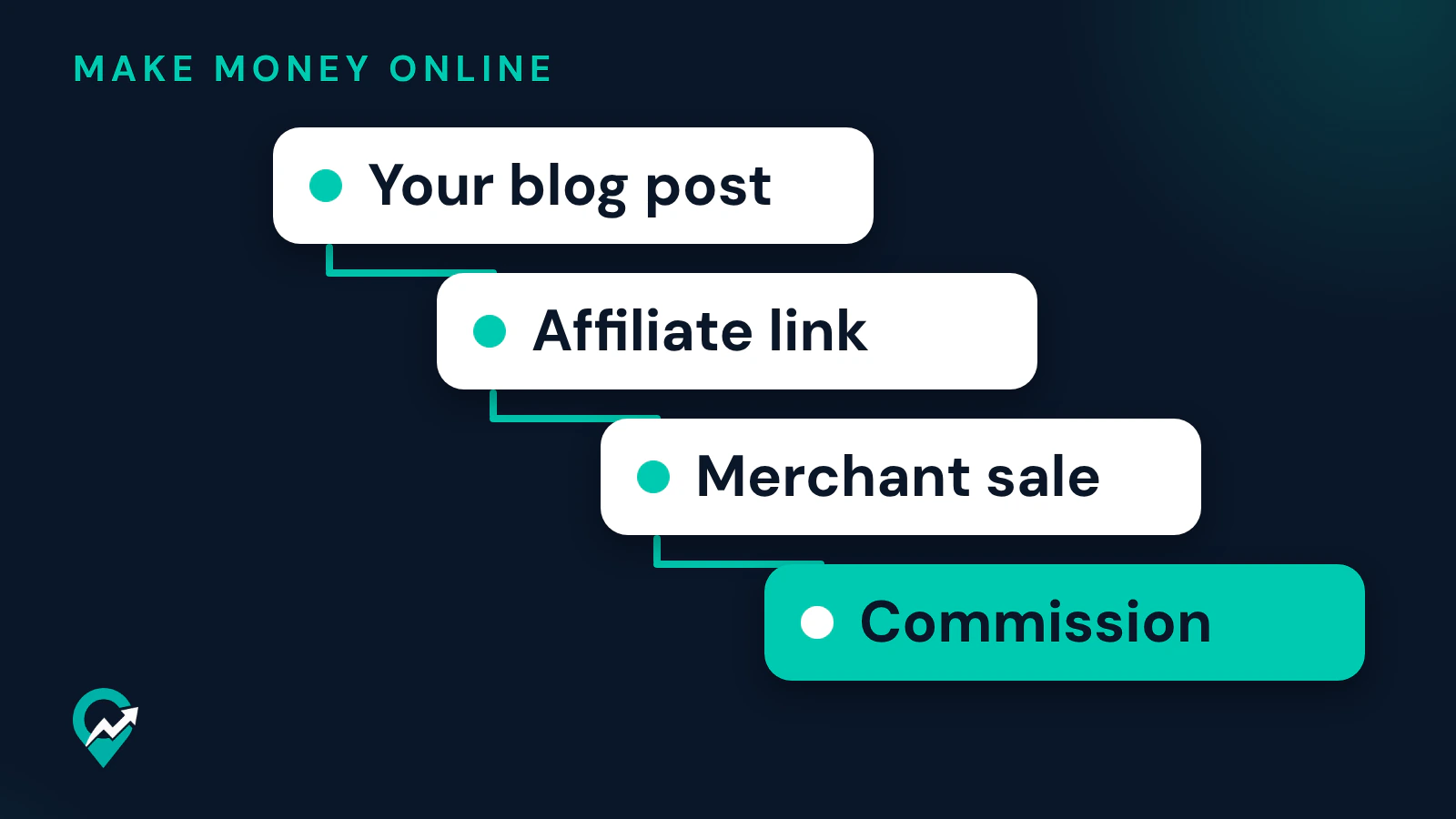
The path is short: your blog post, an affiliate link, a merchant sale, then a commission. You join a program, the program gives you a tracked link, and when a reader follows it and buys, the program credits the sale to your account.
The Etsy Affiliates Program shows the details a program sets. Etsy says each qualifying sale earns a commission, excluding tax, shipping, returns and cancellations, and that its cookie period is 30 days for affiliates. Payout waits until the order is validated after Etsy’s return window closes. Amazon says commission income for qualifying purchases differs by product category and is paid approximately 60 days after the end of the month in which it was earned.
So three numbers decide what a link can pay: the commission rate, the cookie period and the payout rules. Read all three on the program’s own page before you build a post around a product.
Where bloggers join: merchant programs and networks
The pages read for this guide describe two kinds of places to sign up.
| Type | What it is | Examples from the pages read |
|---|---|---|
| Merchant program | One retailer or brand runs its own program | Amazon Associates, the Etsy Affiliates Program |
| Affiliate network | One account gives access to many brands’ programs | Awin, CJ, Rakuten Advertising, impact.com |
A merchant program has one set of rules. Amazon says bloggers, publishers and content creators with a qualifying website or mobile app can join Amazon Associates, and its program page says you can “Earn up to 10% in associate commissions from qualifying purchases and programs.” Etsy says its Affiliates Program “is designed for bloggers, media, and editorial publications.”
A network adds a layer: you join the network, then apply to each brand. Awin says it does not require a minimum follower count to join as a creator, and that individual brands may have their own requirements for joining their programs. Our guide to affiliate programs that accept bloggers (opens in a new tab) compares the entry rules of each program and network.
What a program checks before it approves you
Amazon’s application review page is a good example of what a merchant looks at. It says the Associates team checks your application once you have driven at least three qualified sales within the first 180 days, that personal orders do not qualify, and that all sites must have robust original content, with “a good rule of thumb is at least 10 posts.” It adds that website content must be recent, generally within the last 60 days, and that you must own your website.
That makes the order clear for a new blog: publish useful posts first, then add affiliate links where a reader already needs the product.
The disclosure rules: say it before the link
The U.S. Federal Trade Commission’s endorsement guides (16 CFR Part 255) use a blogger as an example. A coffee lover reviews coffee makers on a blog and includes affiliate links. The guides say that because knowledge of this compensation could affect the weight or credibility readers give to the reviews, “the reviews should clearly and conspicuously disclose the compensation.”
The guides define clear and conspicuous as difficult to miss and easily understandable by ordinary consumers, and they say that online the disclosure should be unavoidable. A line near the top of the post, before the first affiliate link, is hard to miss.
Programs add their own wording. Amazon’s Operating Agreement says you must clearly and prominently state “As an Amazon Associate I earn from qualifying purchases” on your site. This is general information, not legal advice: the disclosure rules of your own country apply as well.
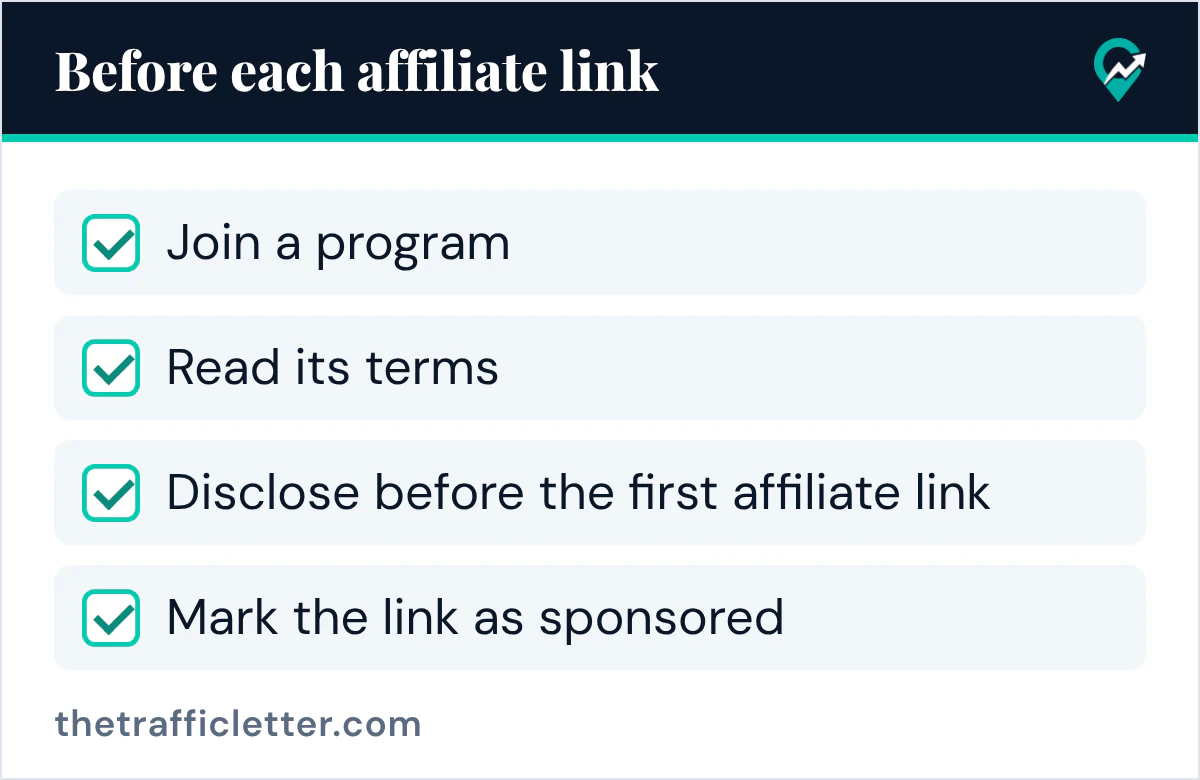
So the order before each affiliate link is: join a program, read its terms, disclose before the first affiliate link, and mark the link as sponsored.
How to mark affiliate links in your HTML
Google’s spam policies list buying and selling links for ranking purposes as link spam, then say that buying and selling links is a normal part of the web for advertising, and that “It’s not a violation of our policies to have such links as long as they are qualified with a rel=“nofollow” or rel=“sponsored” attribute value.” Google’s site reputation section also lists “Using affiliate links throughout a page, with links treated appropriately” among the cases where it does not take action.
Google’s outbound links page says to mark links that are advertisements or paid placements with the sponsored value, and that nofollow is still an acceptable way to flag them, “though sponsored is preferred.” In practice that looks like this:
<a href="https://merchant.example.com/product?ref=yourid" rel="sponsored">product name</a>If your blog platform or a plugin adds the attribute for you, open one published post in your browser’s page source and confirm it is there.
Amazon has two link rules worth knowing too. Its program policies say you will not use a link shortening service in a manner that makes it unclear that you are linking to an Amazon site, and that you will not make inaccurate or misleading claims about any product.
Write affiliate posts that add value
Google’s spam policies define thin affiliation as “publishing content with product affiliate links where the product descriptions and reviews are copied directly from the original merchant without any original content or added value.” The same section says not every affiliate site is thin, and that good affiliate pages offer additional information about price, original product reviews, rigorous testing and ratings, navigation of products or categories, and product comparisons.
Google’s page on writing high quality reviews gives more detail. Among its best practices:
- Provide evidence such as visuals, audio or other links of your own experience with what you are reviewing.
- Discuss the benefits and drawbacks, based on your own original research.
- Consider including links to multiple sellers so the reader can buy from the merchant of their choice.
- When you call something the best, include why, with first-hand supporting evidence.
Pick products that match what your readers already search for. Our guide to Pinterest niches that suit affiliate links (opens in a new tab) has the keyword side, and food bloggers have their own options in our guide to affiliate marketing for food bloggers (opens in a new tab).
Bring readers from Pinterest
An affiliate link only earns when a reader arrives, and Pinterest can send readers to the post that holds the links. You can also put affiliate links on Pins. Pinterest’s affiliate guidelines say affiliate content should be original and add unique value for Pinners, that you should be transparent about the commercial nature of your content and your links, and they list creating affiliate Pins repetitively or in large volumes among the behavior they prohibit. Pinterest’s creator page says it isn’t part of the affiliate agreements, so your commission depends on the terms you set up with the merchant or program.
The Pin side, from link rules to disclosure on a Pin, is in our guide to adding affiliate links to Pinterest (opens in a new tab).
Prompts for your affiliate posts
These prompts work in ChatGPT, Claude, Gemini or any AI assistant. Check every fact they write against the merchant’s page, and add your own experience with the product: Google’s reviews page asks for it.
Write a short affiliate disclosure for the top of a blog post about [topic]. My blog is in the [your niche] niche and the post links to [program or merchant]. Use plain language a reader understands at once, in 1 or 2 sentences. Do not promise anything about prices or results.I am writing a blog post that recommends [product] for [your main keyword]. Build an outline with these sections: who the product is for, what I tested and how, benefits, drawbacks, alternatives from other sellers, and the final verdict. Under each section, list the questions a reader in the [your niche] niche would ask. Do not invent facts or numbers.Right after
- Pick the programs that fit your niche with our comparison of affiliate programs for bloggers (opens in a new tab).
- See how affiliate links compare with ads and sponsored posts in our guide to blog income routes and their entry rules (opens in a new tab).
- Bring readers to your affiliate posts with our guide to sending more visitors to your blog (opens in a new tab).