
A blog can join many affiliate programs, and each one sets its own entry rules. This guide compares the programs and networks bloggers join, using what each official page said on 18 November 2026. It belongs to our guide to how affiliate marketing works for bloggers (opens in a new tab), which covers the disclosure and link rules in more depth.
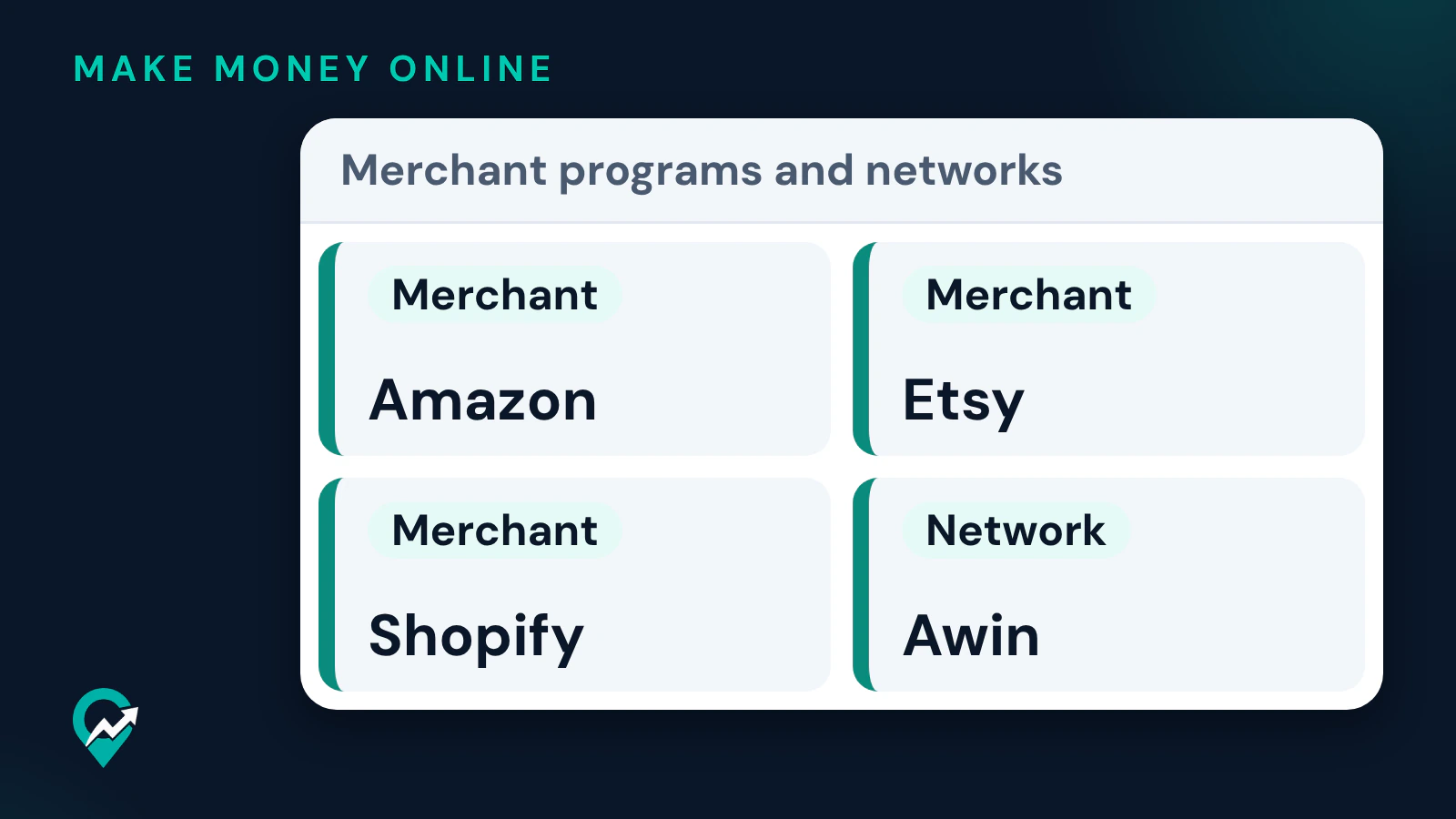
Merchant programs and networks
A merchant program is run by one retailer or brand, so you follow one set of rules. A network is a platform where many brands run their programs: you join the network, then apply to each brand. Both pay you a commission on what your readers buy through your links.
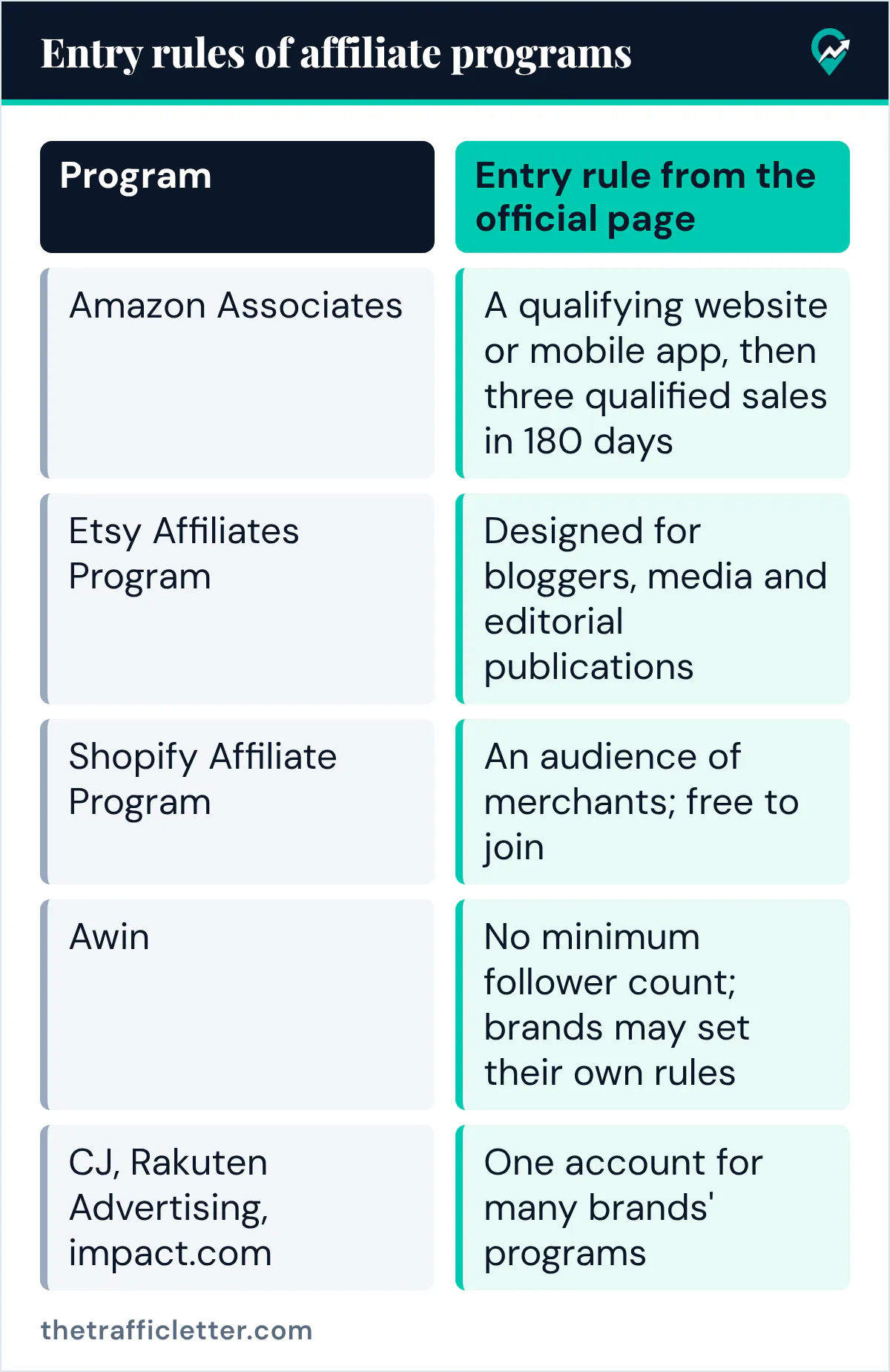
| Program | Type | Entry rule from the official page |
|---|---|---|
| Amazon Associates | Merchant | A qualifying website or mobile app, then three qualified sales in 180 days |
| Etsy Affiliates Program | Merchant | Designed for bloggers, media and editorial publications |
| Shopify Affiliate Program | Merchant | An audience of merchants; free to join |
| Awin | Network | No minimum follower count; brands may set their own rules |
| CJ, Rakuten Advertising, impact.com | Network | One account for many brands’ programs |
Amazon Associates
Amazon says bloggers, publishers and content creators with a qualifying website or mobile app can join, and that commission income for qualifying purchases and programs differs by product category. Its program page says you can “Earn up to 10% in associate commissions” and that commission income is paid approximately 60 days after the end of the month in which it was earned.
The application review page sets the bar:
- The Associates team checks your application once you have driven qualified sales, “at least three within the first 180 days.” Personal orders do not qualify.
- All sites must have robust original content, and the page calls at least 10 posts “a good rule of thumb.”
- Website content must be recent, generally within the last 60 days, and you must own the website.
Amazon’s Operating Agreement also asks you to clearly and prominently state this disclosure, or a substantially similar statement it previously allowed, on your site: “As an Amazon Associate I earn from qualifying purchases.” Amazon says millions of products and programs are available on Amazon, so it fits blogs whose readers buy everyday products.
Etsy Affiliates Program
Etsy says its Affiliates Program “is designed for bloggers, media, and editorial publications,” while its Creator Collective is for social media creators and asks for at least 500 followers on one authorized channel. To join the affiliate side you agree to the terms of Rakuten, Etsy’s third-party partner, and to Etsy’s own terms of use, with no contract to sign.
The terms Etsy states:
- A commission on each qualifying sale, excluding tax, shipping, returns and cancellations.
- A cookie period of 30 days for affiliates, and 7 days for sales through the Etsy app.
- Payment through your Rakuten account by direct deposit, PayPal or check, after the order is validated once Etsy’s return window closes (7 to 14 days).
Etsy fits a blog whose readers look for items sold on Etsy. Our Etsy affiliate program guide (opens in a new tab) covers the Pinterest side of the same program.
Shopify Affiliate Program
Shopify’s program pays for a different kind of referral: a new merchant who signs up for a full-price Shopify store plan through your link. Shopify says the program is “completely free to join,” that you can earn up to $150 USD per qualified referral, and that commission amounts vary by referral location.
Shopify says ideal affiliates own and manage an active website, have an established audience, create original content focused on commerce or entrepreneurship and have experience with Shopify or other commerce platforms. It also says not every application is approved and that applications are typically processed within 24 hours. Shopify says it tracks referrals for 30 days from the moment someone opens your link, and withdrawals need a minimum balance of $10 USD.
Given those criteria, this program fits blogs about starting an online shop or running a business.
Affiliate networks: Awin, CJ, Rakuten Advertising and impact.com
A network gives you one account for many brands’ programs, and a brand can still set its own requirements, as Awin’s page says.
- Awin says it does not require a minimum follower count to join as a creator, that general requirements include an active digital platform and the ability to share affiliate links, and that individual brands may have their own requirements. Its page names payment methods such as SEPA, BACS and ACH.
- CJ describes a publisher onboarding that gives access to its network of brands, where you can join brands’ programs from the platform, and a Deep Link Generator tool that creates tracking links from a brand site.
- Rakuten Advertising runs a publisher sign-up for its network of brand partners, and it is also the partner behind the Etsy Affiliates Program.
- impact.com describes itself as a partnership management platform connecting brands with affiliate publishers, creators and advocates.
Because a brand can set its own requirements, it helps to have posts in the brand’s niche before you apply, so the brand sees what you publish.
How to choose your first programs
Start from your readers, not from the commission rate. List the products your posts already mention, then check which program sells them. Three checks before you apply:
- Entry rules: does the program ask for sales, posts, an audience or a niche you already have?
- Terms: the commission, the cookie period and the payout threshold, from the program’s own page.
- Fit: Google’s spam policies say good affiliate pages offer original product reviews, rigorous testing and ratings, and product comparisons, so pick products you can write about in that depth.
Our affiliate programs for Pinterest (opens in a new tab) guide covers which of these programs also allow links on Pins, and food bloggers can see the options that fit recipes in our guide to affiliate links on a food blog (opens in a new tab).
A prompt to shortlist programs
This prompt works in ChatGPT, Claude, Gemini or any AI assistant. It gives you a shortlist to check, not an answer: confirm every rule on the program’s page.
My blog is about [your niche] and my most visited posts are about [topics]. List the kinds of products my readers would buy after reading these posts, grouped by product type. For each group, say whether a general store program, a handmade marketplace program or a brand program through an affiliate network would fit better, and why. Do not give commission rates or numbers: I will check them on each program's page.Right after
- Set up your disclosure and your link attributes with our guide to the disclosure and link rules for affiliates (opens in a new tab).
- Compare affiliate income with ads and sponsored posts in our guide to generating income from a blog (opens in a new tab).
- Find the niches where affiliate content does well on Pinterest in our guide to the best niches for Pinterest affiliate marketing (opens in a new tab).